

Any day in Africa is a good one. African skies are big and beautiful. Sunrises are amazing and only surpassed by sunsets. Living in the bush is as far as you can get from noise, pollution and the everyday concerns of life in the fast lane. The sounds, smells and sights stimulate the senses. There are no phones or constant chatter to divert attention, no traffic noise, no sirens, no motorcycles or aeroplanes, no lawnmowers or chainsaws. Your nearest neighbour is likely to be miles away. You wake up to birdsong and maybe the trumpet of an elephant or the distant call of a hyena. If on your bush walk you smell potatoes, it will be the potato bush giving off its distinctive aroma. If you’re in your go-anywhere Landcruiser, your tyres might crush the coconut scented thyme. Rock-splitting fig trees balance precariously on their host rocks, warmed by the hot sun. You’ll see dwarf mongooses and tree squirrels dashing across the ground, a yellow-billed hornbill sitting on a termite hill or Africa’s most photographed bird, the violet-breasted roller, posing for pictures.
For us, every day brings a sense of anticipation because we have no idea what we will find. Rarely is a day uneventful since one moment of quiet can turn in an instant to breathtaking action or simple visions of beauty. Any meeting with wildlife here demands respect because there are inherent and, sometimes, unpredictable dangers. We are relatively safe in our vehicle but the safety of the animals is much more uncertain. The sweet song of the birds is often interrupted by an alarm call when a predator is about because, for the animals, everyday life means living on the edge. Have a day off from watching your back and it could be your last as there is always something looking for a meal. Here are the ‘big five’- elephant, buffalo, rhino, lion and leopard, and while the first three present no threat to other animals, there are plenty of others that do.
Lions and leopards never mix unless by chance. When we arrived at Wild Dog Dam in Klasserie, South Africa, we were looking for a leopard cub that we had seen the previous day. Instead, we found a pride of lions blending into the shade of a thorn bush.
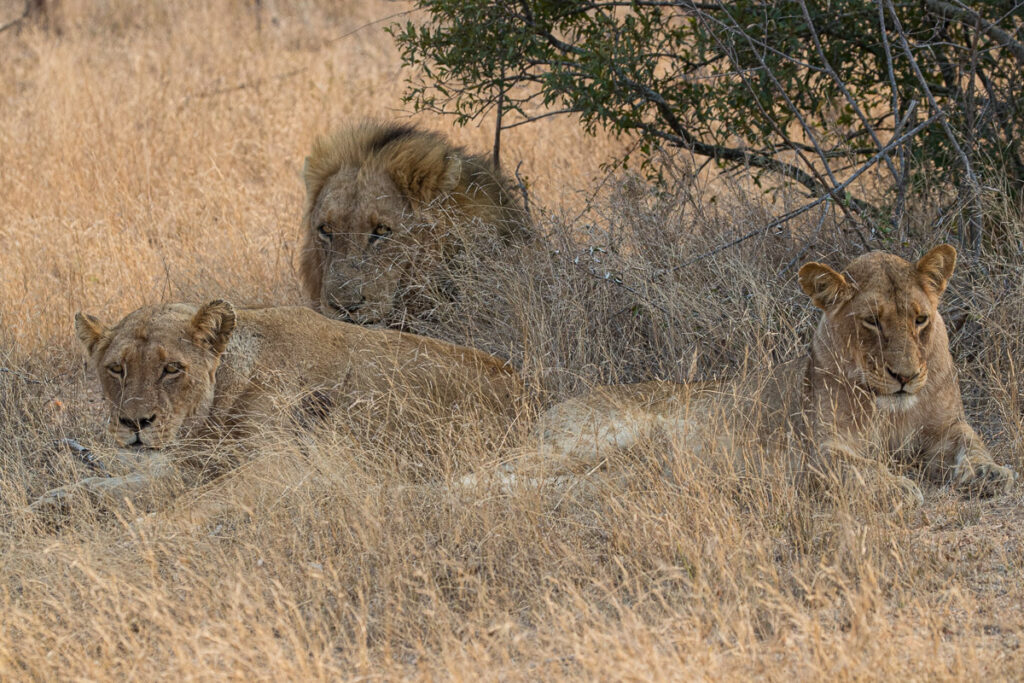
But after a quick scan of the surrounding area, we spotted the young leopard watching the lions from its rocky, down-wind vantage point. For us, this was proving to be, potentially, very interesting but it seemed, for now, that the lions were completely unaware of the presence of the cub.

However, any suggestion of an interaction between these animals was stalled, first by the arrival of a large herd of impala who wanted to drink at the water hole and then by a single zebra. One of these beautiful small antelope would make only a tasty snack for a pride of hungry lions but thirty pairs of impala eyes are a good defence against a stalking predator and it wasn’t too long before the whole herd beat a hasty retreat as a single lioness began her stealthy approach. Thirst got the better of the zebra, however, and he cautiously approached the water and began to drink. Head down to quench his thirst, he was blissfully unaware until the last moment of the coming lioness. As she closed in, the zebra’s senses revived and he was off, kicking up dust in the face of the big cat as his hooves bit into the earth. It was an exciting but very short chase as the zebra made ground. The lion soon gave up and the zebra escaped to live another day, a salutary lesson learned.

But in Africa, you do well to expect the unexpected. The chase over, the panting lioness found herself recovering in a different place and with a different view. Moments later, she stood up and began to circumnavigate the water hole, her eyes firmly fixed on the rock where the young leopard was lying. As she picked her way through the thorn trees, she was joined by another lioness and then another, some seemingly silent communication bringing them together. Discretion being the better part of valour, the leopard quickly removed herself from the scene but the lions kept on walking.

We next found the young leopard looking very relaxed, lying in the upper branches of a tree. Fifty metres away, another leopard stood high against a perfect blue sky in the canopy of another tree with the three lionesses settled at the bottom – a stand off for the time being.
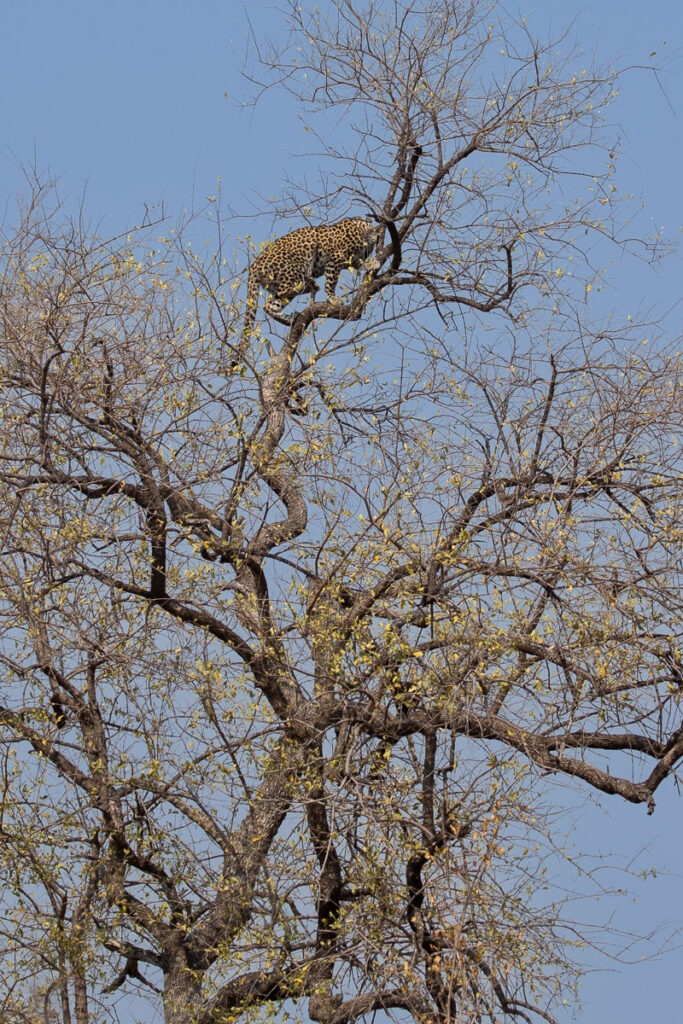
This dramatic event, whilst bringing some uncertainty for the leopards, will have had a positive outcome for the other animals who needed to drink. The water hole, having been abandoned by the lions, was now for the time being, safe to access.
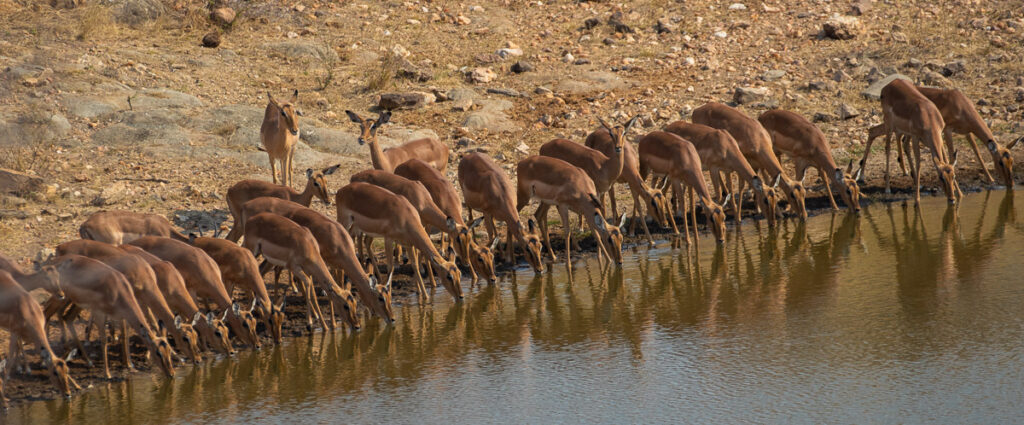
There will be an end to this story but I don’t know what it is. We had to leave the cats to sort out their differences unobserved. The consensus was that the patience of the leopards would be rewarded as the lions would lose interest and move on to easier and more satisfying prey. After all, the leopard isn’t a meal, it is simply a competitor to be eliminated. For the sake of these stunningly beautiful leopards, I hope we were right.
Growing up for a young leopard is a constant challenge. They are often left alone for up to two or three days while their mother hunts. They don’t want to move too far because mum will eventually return to bring food or take them to a kill. While mum’s away, the cats will play but, while they do, their survival depends on their senses and reactions being constantly honed to the more unwelcome features of the African bush.
This Post Has 0 Comments