
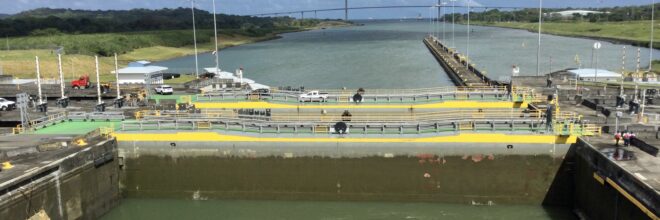
The Panama Canal was first transited in 1914 when ships were a tad smaller than many are now. Eventually, the locks were unable to accommodate the bigger vessels and new locks were completed in 2016, so much bigger that, now, Cunard’s flagship ocean liner, Queen Mary 2 can nicely fit in and find it’s way up to San Francisco without navigating South America’s treacherous Cape Horn and consuming the enormous time/distance involved in doing so. However, there’s another tricky bit to deal with in the form of the Bridge of the Americas which spans the canal, because Queen Mary 2 is too high to fit under it except at low tide. This means her hanging about a bit until she can safely squeeze underneath. This, she did, in January this year for the very first time, with a few feet to spare.
For those unfamiliar with the Panama canals, there are two sets of locks at each end connected by a massive, artificial, navigable expanse of fresh water called the Gatun Lake. Here there are numerous channels spreading out across the landscape which provide small boat access to the somewhat reduced habitat in which animals including howler monkeys, capuchins, snail kites, ospreys, crocs and various water birds, reside.
A positive side effect of sailing through such an iconic feat of engineering is that humans, who would otherwise be occupying the bars and lounges of Queen Mary 2, or exposing their often ample bodies to the tropical sun, actually look over the side to witness the event. These same people comment that they haven’t seen a whale all trip, largely because they didn’t make the effort to look for one.
But before you encounter the canal going west, you have to pass through the Caribbean Sea which, for a happy snapper, is always a hoot. You have to spend your time peering over the side of the ship looking for flying fish leaving the water to avoid the vessel and, when you find them, you’ll almost certainly be joined by boobies of the brown, masked and red-footed variety who are familiar with this fishy behaviour. Boobies are in the same family as our gannets and are master fisherfolk. A flying fish launching itself out of the water to escape the jaws of Queen Mary 2 is soon pursued by a more voracious predator in the form of one or more boobies. A favourite escape strategy of the fish being pursued by a booby is to return to the safety of the water but, in forming that strategy, they fail to account for the bird’s determination, speed and diving skill. These birds put Tom Daly to shame as they hurl themselves into the water and use their webbed feet to pursue their prey, invariably emerging with the hapless fish in their bill.
If this isn’t photographer heaven, given a few strokes of luck coupled with a good dose of observation, the journey up the Western Pacific can be. Here are turtles, fish, whales and dolphins which may, by chance, swim close enough for a decent pic, or through sheer curiosity approach the ship and, for whatever reason, put on a performance worthy of Sea World. While we are prepared to see humpbacks, grey whales and dolphins on our journey north, the appearance of the occasional dancing marlin and a sizeable pod of orca in party mood is a massive bonus.
As an aside, having a camera usually provides an element of identification certainty to these marine-life sightings. It’s encouraging to see fellow travellers taking an interest in wildlife but some sightings are based on wishful thinking rather than scientific observation. Some pods of dolphins are porpoising sea-lions, a humpback whale is actually a grey whale, and a grey whale is certainly a whale that is grey but certainly not a grey whale.
Back to dry land, and a trip by Uber from the port of San Francisco to Santa Cruz to visit precious friends gives me the opportunity to shoot the tiny but splendid Anna’s and Alan’s hummingbirds cavorting in the university of California’s arboretum.
Then, south-west through Pacific waters towards Hawaii where the promise of thousands of breeding humpbacks feeds our hopes and expectations. But the reality does not live up to Hawaii’s reputation. Arriving into and leaving Honolulu in the dark probably doesn’t help and our whale-watching trip is underwhelming, with sightings of only three humpbacks just breaking the surface. Five days at sea produces only a small pod of sperm whales and the occasional pelagic bird, the most exciting being distant views of Laysan albatross. Here, the ocean is around 14,000 feet deep or, to put it into perspective, around 4 kilometres. Captain Tom from Ireland reports our position every noon and for context, gives us the distance from random places around the world including from the post box at the end of his street, To the Americans it’s gobbledegook because they can’t tell a word he’s saying. To most people, the numbers may as well be from a sudoku puzzle. We are hundreds of nautical miles from anywhere. In the biggest ocean in the world, it isn’t surprising that we see only one other ship between San Francisco and the next destinations, Papeete and Moorea in the French Polynesian Islands. Bird life on the islands is restricted to, mostly, sea birds but an introduced chestnut-breasted manikin and a wandering tattler make an appearance together with a couple of argumentative great crested terns. In an impromptu snorkelling session, we meet up with friendly sting rays and black-tipped reef sharks, together with some very colourful and equally friendly humans.

We are now at sea again and will arrive in the Bay of Islands, North Island, New Zealand in a few days. Meanwhile, the Pacific Ocean is guarding its residents very carefully. Yesterday, we were excited to spot a couple of tropicbirds and, in a maelstrom of white water, what was possibly a shoal (school or tin?) of tuna. Today, we hit a big bump in the ocean as we crossed the international date line, which means we will skip the 24th of February and go directly to the 25th. To those with their birthday on the 24th, we sang on the 23rd.
And the remainder of the journey to New Zealand was un-spectacular! Petrels out at sea and a marooned red-tailed tropicbird on the ship which was rescued and returned to the ocean by a deckhand, completed the box of ticks. We arrrived in the Bay of Islands safely after a very long journey across the Pacific and a great little trip on a catamaran in the bay produced my best dolphin shot ever, and a good New Zealand BBQ!
So, we are here and a new land-based adventure awaits us, which might or might not produce another little blog…
This Post Has 0 Comments