

Avenue of the Baobabs
Madagascar has been on our agenda for a long time but, if I’m honest, I was put off by the concentration on lemurs and the need for lots of travelling to see the variety of wildlife on offer. The island is the fourth largest in the world and has diverse nature in its many different environments.
But in October, we finally arrived in Antananarivo to temperatures of 30-35c. We were advised by our travel agent against travelling by road unless there was no other option, so we used Madagascar Airways to reduce the driving and left the capital pretty quickly.
Our first port of call was Morondova on the west coast and a two hour drive over sandy bumpy roads brought us to the Kirindy reserve where, yes, you guessed it, there were loads of lemurs, and a few interesting birds – but definitely lemur-land. Here it was very dry and hardly any greenery. Many of the animals are nocturnal so there was always a night walk with the associated difficulty of photographing by torchlight. In Kirindy, however, the target animal is the fossa, Madagascar’s largest carnivore which resembles a puma crossed with a mongoose, but is unique to this country. We found the fossa quite easily because it is mating time and, apparently, they stick around the same area during this time.
We stayed for 3 days before negotiating our way to our next port of call, Fort Dauphin. The logistics of this journey were not simple as we had to fly back to Antananarivo, spend another night in the city before flying south. This was going to be a bit of a pattern since we would spend yet another night in the same hotel later in the trip. So, the message is, if you’re planning a trip here, be prepared to spend a good proportion of your time in airports, on rough roads, and in transit hotel stays. And be prepared for domestic flight times to change at short notice.
Berenty is a two hour drive from Fort Dauphin. Here, we enjoyed watching the antics of the dancing Vereaux’s sifakas, who do just that when moving from place to place.
I’m not going to list the species we saw in each area because you can find them, together with a brief description, with the images on my front pages but I will mention a highlight or two. For instance, the touristy thing is to visit the Avenue of Baobabs to photograph the setting sun. Don’t miss it. It was pretty spectacular and our guide assured us it is the most photographed scene in Africa. Don’t miss it because not only is it a great photo opportunity but it is a bit of an occasion. Tourists from all around gather for the hour, some have champagne and nicely set tables, others have canapés and drinks, and there are the inevitable tick-tockers doing their thing. A group of 41 Russians arrived as if dressed for the ball and one had to launch his drone despite the ample prohibition warning signs. Another had an artificial leg, his natural one having been taken off by the Ukrainians. Some of the local boys put on amazing dancing shows and entrepreneurial farmers gave rides on their carts, hauled by zebu, the local cattle (and providers of the meat you will be offered for dinner every day).
As a bit of an aside, the Russians happened to be in our Morondova hotel overnight and, suffice to say, they were not good house guests.
In all, we visited three wildlife reserves in two weeks, the third being Andasibe where we saw more lemurs in the rainforest, and added on a trip to Nosy Be (trans. ‘Big Island’) on the north coast where we went looking for whale sharks and turtles. A few more days over the water at Eden Lodge was a splendid means of winding down ready for the trip home.
So, would I go back to Madagascar? If you are a lemur fan, you have to, as there are none anywhere else in the world. And there are plenty of other endemic species to be found. I lost count of the number of times an animal was identified with the prefix, ‘Madagascar’. If you are a photographer, you will find photographing lemurs sometimes challenging. They inhabit the trees, often in the canopy, and there is a constant battle to find a window for a clear shot. However, the bigger challenge is the light. As you’re almost always shooting upwards in a forest, the light is constantly changing and requires regular exposure compensation to produce an acceptable image.
if you are not a lemur fan, or have been lemured-out, you will have difficulty finding a trip that does not want you to see all the lemurs again. They are what most people go for. For me, it was very good but once is enough.
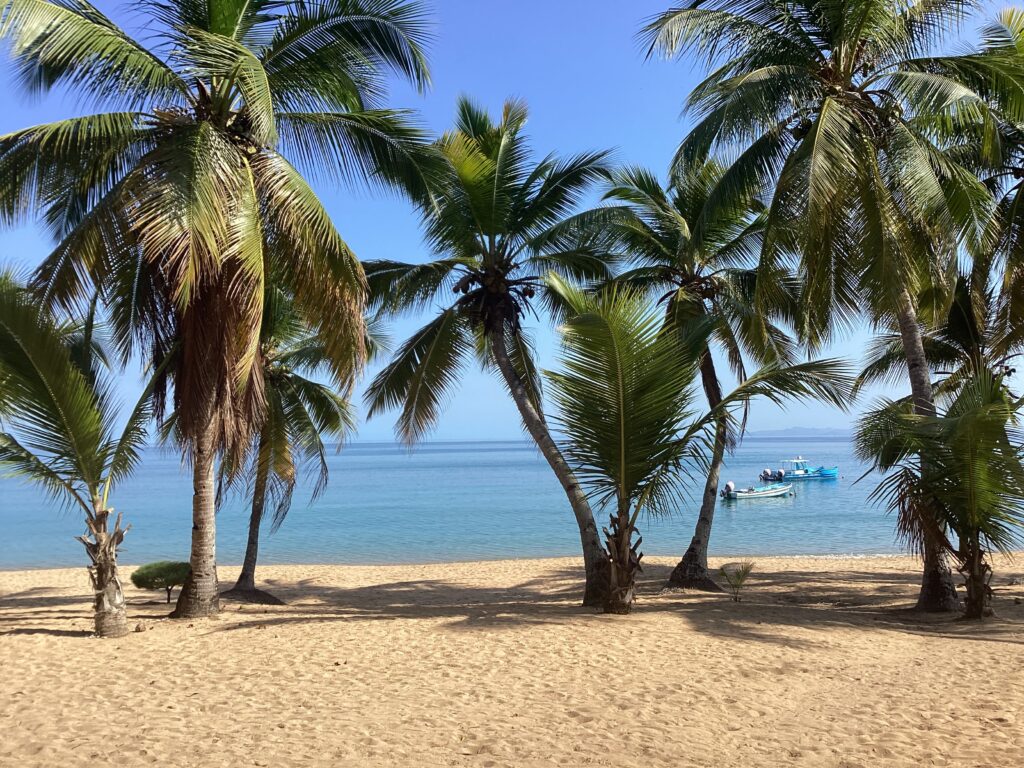
If you want to relax by the beach in almost total solitude, look up Eden Lodge, a one hour boat ride from Nosy Be. There are more lemurs and a few birds, but a snorkel out to the reef will produce thousands of colourful fish and the chance of an encounter with hawksbill turtles.
The images from this trip are now available to view.
This Post Has 0 Comments