

Royal tern, Florida
If I could afford a second home in the sun, it would probably be on Sanibel Island, Florida, where the weather is generally amazing, the population fairly laid back, and the wildlife both prolific and fascinating. I’m writing this from our apartment balcony on the gulf beach and my wife tells me Allan the alligator lives in the pond we’re looking down on. I have yet to go down and see him. But my friend Paul and I have been to the Bailey Tract this morning and, after a slow start, spotted red-bellied and pileated woodpeckers, a tiny gator, a very wet osprey, and three playful American river otters.
We arrived in Florida aboard Queen Victoria, having spent 11 days crossing the Atlantic, sharing a dinner table with some delightful friends, including Keith who I met on Victoria’s deck a couple of years ago. We met our Californian friends, Paul and Barbara in Fort Lauderdale and have since been exploring more of the Great Florida birding trail. From Fort Lauderdale, we visited Loxahatchee, Green Cay and Wakodahatchee wetlands near Palm Beach, where you can get pretty close up and personal with some amazing water birds – wood storks, anhingas, ibis, great blue, little blue and green herons, great and snowy egrets, double-crested cormorants, roseate spoonbills, purple gallinules, and swamp hens. Massive iguanas patrol the grassland or laze about in the trees, their camouflage making it quite difficult to spot them without a great deal of searching.
The gem of Sanibel is the ‘Ding’ Darling nature preserve where you can spend hours watching all kinds of wildlife including dolphins, gators, jumping mullet, brown pelicans, the massive American white Pelican with its 9′ wingspan, and even the fairly rare, reddish egret. Ospreys are common place on Sanibel and you can rarely go a few minutes without seeing or hearing one.
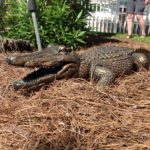
So, this is the innocuous, Allan, the alligator. Only when you get up close do you realise he has been sitting there for a long time!
We had a busy day today in and around the Bailey Tract and on the beach, where sandwich and Royal terns, ring-billed gulls, and willet entertained us with their preening and feeding antics. The best entertainment of the day came unexpectedly. All was pretty quiet in Ding Darling where we were watching a solitary brown pelican fishing. He caught an enormous fish that he couldn’t swallow. His efforts were noticed by a passing American white pelican, who at twice the brown’s weight, looked a formidable threat. What followed was fascinating. The brown tried to fly off but his efforts were hampered by the size of the fish. The white tried to steal the fish right out of the brown’s bill but the brown persisted, and finally took away his prey. The photos will be interesting to say the least.
We were reluctant to leave Sanibel but needs must, and we headed off to Venice via 6 Mile Cypress preserve where we came across snakes for the first time this trip – three venomous cottonmouths (known also as water moccasins) and another swimmer which we have yet to identify. A banded kingfisher held our attention for a good half hour but flew off without fishing. Myakka River was interesting but blustery following a storm the previous night. This limited our viewing but still brought us ospreys, gators, a beautiful courtship display from two great blue herons, a fly past from a northern crested caracara and the return to their roosting sites of a great flock of sandhill cranes.
Wherever you go in Florida, there is a wildlife spot of interest. We were forced to choose between a few reserves north of Sarasota and selected Celery Fields only for its proximity to the interstate. A small reserve owned privately by the Audubon society and sporting two small boardwalks, it was a delight. Osprey fished in the ponds directly in front of the boardwalk, a northern harrier quartered the reed beds and an American kestrel showed nicely on nearby wires. A limpkin and a great blue heron posed for close-ups. North of here near Apollo beach is a manatee viewing centre. Here, manatees by the dozen gather in the warmer waters of the electricity generating station, whose owners have provided viewing platforms for the past 30 years.
And from there to Kissimmee where the wildlife hotspots were only luke warm, maybe to acclimatise us for what lies in store tomorrow when we arrive in Manchester, U.K.
Check the site for the usual Florida suspects, plus snakes, fighting pelicans, brawling ospreys and bald eagles, and the most beautiful North American bird, the painted bunting.
This Post Has 0 Comments